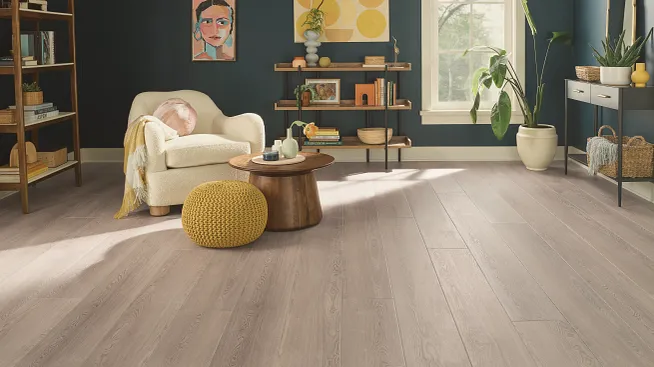
A flooring sample can get you into trouble.
It sits there in your hand looking innocent. The color seems right. The grain looks pretty. Someone says “waterproof,” and before you know it, you are mentally ripping out half the house and imagining this one little plank running through the kitchen, hallway, family room, and maybe the basement too.
That is exactly when you need to slow down.
COREtec flooring can be an excellent choice for busy homes, especially for homeowners who want the look of wood without living in fear of every spill, muddy shoe, pet accident, or dragged kitchen chair. But a good flooring decision is not made from the prettiest plank on the sample board. It is made by asking what that floor will look like, sound like, feel like, and tolerate once it is installed across real rooms with real lighting and real people.
The sample is only the invitation. The floor still has to live in your house.
Why COREtec Flooring Gets So Much Attention
COREtec became popular because it speaks to a problem homeowners actually have. Most people are not replacing flooring for fun. They are replacing something scratched, stained, dated, swollen, faded, buckled, dingy, or impossible to keep clean.
They want the house to look better. They also want the new floor to survive the house.
That is where COREtec flooring makes sense. It sits in the luxury vinyl flooring category, but it earned attention because it gave homeowners a more convincing wood-look option with waterproof construction, easier maintenance, and a softer approach to everyday wear than many traditional hard-surface floors.
For a lot of families, that matters more than flooring purists like to admit.
Hardwood is beautiful, but it asks things of you. It notices water. It notices humidity. It notices the dog. It definitely notices the chair someone keeps dragging backward from the breakfast table like they are trying to start a bar fight. Tile can be durable, but it can feel cold and hard. Carpet may be comfortable, but it is not always the right answer for kitchens, basements, mudrooms, or pet-heavy spaces. Cheap vinyl may solve one problem while creating another: a floor that looks flat, thin, or fake once it covers a large area.
COREtec appeals because it offers a more practical compromise. You can get a wood-inspired look without treating the kitchen like a historic museum exhibit. You can run the same flooring through several spaces without worrying quite so much about moisture-prone rooms. You can choose something attractive without pretending your household is calmer than it is.
That last part is important. The best flooring choice is rarely the one that matches your fantasy life. It is the one that works for the house you actually live in.
The Word “Waterproof” Should Not End the Conversation
“Waterproof” is one of those flooring words that can make shoppers stop listening.
They hear it and think the problem has been solved. Spills? Fine. Pets? Fine. Basement? Fine. Laundry room? Fine. Life? Fine.
Not so fast.
Waterproof flooring means the flooring material itself is designed to handle water exposure better than many traditional products. That is useful. It is one of the reasons homeowners look at COREtec in the first place. But waterproof does not mean careless-proof. It does not mean leaks can be ignored. It does not mean water should sit under the floor. It does not mean a damp, uneven, dirty, or poorly prepared subfloor suddenly becomes acceptable.
A waterproof floor still needs a proper installation.
This is where homeowners often get the order of importance backward. They may spend weeks choosing between two colors and barely think about what is underneath the floor. But the subfloor is not some boring technical footnote. It is the surface your new floor has to live on every day. If it is not flat, clean, dry, and suitable for the product, the finished floor can telegraph problems you thought you had covered up.
The pretty plank gets the attention. The subfloor gets the blame when things go wrong.
Where COREtec Makes the Most Sense
COREtec flooring is especially useful in rooms where homeowners want the look of wood but need more tolerance than wood usually gives them.
Kitchens are the easy example, but not because every buying guide says so. Kitchens punish flooring in several different ways at once. You have water near the sink and dishwasher. You have chairs scraping in and out. You have crumbs, grease, steam, dropped pans, pet bowls, and the occasional mystery puddle nobody in the house wants to take responsibility for.
A real wood floor in a kitchen can be gorgeous, but it requires a certain level of household discipline. COREtec gives homeowners a wood-look option without asking everyone to behave like museum staff.
Basements are another natural fit. Many basements are trying very hard not to feel like basements. The right floor can help turn that lower level into actual living space instead of the place where old furniture goes to be forgotten. COREtec can bring a warmer, more finished look while giving homeowners more confidence around moisture than they would usually have with hardwood or carpet.
Mudrooms, laundry rooms, family rooms, rental properties, lake houses, and homes with pets are also worth considering. These are not rooms where people want fragile flooring. They want a floor that looks good when it is cleaned up, not a floor that demands a family meeting every time someone walks in with wet shoes.
COREtec can also work well in open floor plans. Many homeowners want one continuous surface through the kitchen, breakfast area, living room, hallway, and sometimes even bedrooms. That is not always easy with materials that have strict moisture limits or comfort drawbacks. A luxury vinyl plank like COREtec can help create a cleaner visual line from room to room.
But continuity cuts both ways. If you run one floor through 1,200 square feet, you had better like more than the sample. You need to understand the full range of color, grain, texture, and plank variation because you are not buying one board. You are buying a field of boards.
The Sample Board Problem
Samples are necessary, but they are also sneaky.
A single plank cannot show you the whole floor. It cannot show how much variation comes in the carton. It cannot show how the lightest board will look next to the darkest one. It cannot show whether a knot, streak, bevel, or gray undertone that seems harmless in the store will bother you once it is spread across the kitchen.
It also cannot show your house.
Your cabinets matter. Your trim matters. Your wall color matters. Your fireplace stone, countertops, rugs, furniture, and natural light all matter. A floor that looks warm in a showroom may turn oddly yellow at home. A gray that looked elegant under store lighting may look cold next to cream cabinets. A brown that seemed rich on the display may pull red next to your existing woodwork.
This is why the prettiest plank is not the one to judge by.
Judge the busiest plank. Judge the quietest plank. Judge the lightest plank, the darkest plank, and the one you secretly hope does not show up too often. If the floor has rustic variation, look at the most rustic board. If it has knots, find the biggest knot. If it has saw marks or mineral streaks, decide whether you like them or merely tolerated them for ten seconds in a sample.
That is how you avoid the classic flooring mistake: choosing from the highlight reel instead of the full cast.
Color Is Not the Whole Decision
Homeowners usually shop by color first. That makes sense. Color is what grabs you. Nobody wants to spend good money on a floor they dislike every time they walk into the room.
But flooring is not paint.
You cannot reduce it to “warm oak,” “light brown,” or “not too gray.” The plank size, surface texture, bevel, pattern repeat, attached pad, wear layer, and overall construction all affect how the floor behaves once installed.
A wide plank can make a room feel calmer and more open, but in a narrow hallway or chopped-up floor plan, it may not land the way it did in the showroom. A more varied plank can bring life to a plain room, but across a large open area it may feel busier than expected. A heavy texture can help disguise everyday scuffs and traffic, but it may not suit a cleaner, more tailored interior. A dramatic grain can look beautiful on one board and restless across an entire great room.
Then there is the way the floor feels.
Homeowners often think about the picture first. They forget about sound and touch. Does the floor feel solid underfoot? Does it sound hollow? Does the attached pad help? Does the texture feel comfortable? Does the product make sense for the rooms where people will actually walk, stand, cook, work, and live?
A floor can look perfect online and still annoy you in person. Screens are terrible flooring consultants. They do not know your lighting, your cabinets, your dog, your stairs, or the way your house sounds when someone walks through it at 6 a.m.
COREtec Is Not One Single Floor
One of the easiest mistakes is treating COREtec like one product.
It is not. COREtec has different collections, constructions, plank sizes, thicknesses, textures, visuals, and performance details. The question is not simply “Should I buy COREtec flooring?” The better question is “Which COREtec floor fits this house?”
That is a much more useful way to shop.
Some homeowners need a floor that handles pets and heavy traffic. Some need a product that looks refined enough for a main living area. Some are trying to make a basement feel less basement-like. Some are replacing builder-grade flooring and want the whole first floor to feel more finished. Some care most about comfort underfoot. Others care about color consistency, plank width, or how realistic the wood visual appears in natural light.
Those are different problems. They should not all lead to the same product.
This is where working with a knowledgeable flooring retailer helps. A good retailer should not just point to a color wall and wait for you to fall in love. They should help you compare construction, wear layer, plank size, underlayment, installation requirements, trims, transitions, and whether the product actually suits the rooms involved.
The right floor is not the one that wins the beauty contest in the store. It is the one that still makes sense after the installer shows up.
COREtec Compared With Hardwood, Laminate, and Cheaper Vinyl
Most homeowners compare COREtec to hardwood first because hardwood is still the standard in many people’s minds. That is understandable. Hardwood has history, natural variation, and long-term appeal. It can add real value and beauty to a home.
But hardwood is not always the easiest floor to live with.
Water matters. Humidity matters. Scratches matter. Refinishing may be possible, but that does not mean every homeowner wants to move furniture, deal with dust, and live through the process. Hardwood is wonderful in the right setting, but it is not automatically the right answer for every kitchen, basement, mudroom, rental property, or pet-heavy home.
COREtec should not pretend to be hardwood. Its strength is different. It gives homeowners a wood-inspired look with a more forgiving maintenance routine. That trade-off is exactly why many people consider it.
Compared with laminate, COREtec often attracts shoppers who are worried about moisture. Laminate has improved, and some products are genuinely impressive, but homeowners still need to understand each product’s water limitations, seam behavior, and installation requirements. COREtec’s waterproof construction gives it an advantage in rooms where spills and moisture are part of daily life.
Compared with cheaper vinyl, COREtec is usually being considered by homeowners who want the floor to look and feel more substantial. A lower-priced vinyl may photograph well, but the difference can show up later in the locking system, texture, finish, thickness, comfort, and installation results.
In plain terms, do not buy only the picture. Buy the build behind the picture.
Mistakes to Avoid Before Ordering COREtec Flooring
The first mistake is falling in love with one sample plank.
That plank may not represent the whole floor. Ask to see multiple boards if possible. Look at installed photos, but do not rely on them completely. Take samples home. Move them around. Put them beside cabinets, trim, furniture, tile, and countertops. Check them in morning light, afternoon light, and evening light.
The second mistake is ignoring the subfloor.
COREtec can be forgiving, but it is not a magic trick. Uneven areas, moisture problems, damaged surfaces, and poor preparation can all affect the finished installation. If the floor underneath is wrong, the floor on top may never feel right.
The third mistake is misunderstanding “waterproof.”
Waterproof flooring is not an excuse to ignore leaks, standing water, wet basements, bad drainage, or moisture underneath the floor. It is a feature, not a force field.
The fourth mistake is forgetting the edges of the job.
Flooring does not stop in the middle of the room. It has to meet doorways, stairs, fireplaces, cabinets, bathrooms, closets, hallways, and other flooring materials. That means trims, moldings, stair noses, reducers, and transitions matter. They are easy to overlook during shopping and painfully obvious when they are wrong.
The fifth mistake is choosing a floor for the room you wish you had instead of the house you actually live in.
If you have dogs, shop like you have dogs. If your kitchen is busy, shop like your kitchen is busy. If your basement has had moisture issues, do not pretend it has the temperament of a second-floor guest bedroom. Flooring decisions get easier when you stop flattering the house and start being honest about it.
When COREtec Is Worth the Money
COREtec flooring is worth considering when you want a floor that looks good in the main parts of the home but does not require the same level of caution as hardwood. It can be a strong option for kitchens, basements, family rooms, laundry areas, open layouts, homes with pets, and households that need a floor with some patience.
It is also worth considering when you want visual continuity. Running one flooring style through several rooms can make a home feel cleaner, larger, and more connected. But that only works if the product is right at full scale, not just attractive in a sample.
The best COREtec floor is not automatically the most expensive one. It is not automatically the trendiest color. It is the product that fits the architecture of the house, the habits of the people living there, the condition of the subfloor, and the abuse the room is likely to take.
That is the real lesson behind the pretty sample.
A sample can tell you whether you are interested. It cannot tell you whether the floor is right. Before you order, look at the construction. Ask about the collection. Compare plank sizes. Study the variation. Think about the light. Think about the stairs. Think about the pets, the chairs, the dishwasher, the basement, and the rooms that do the most work.
A beautiful floor is easy to want.
A beautiful floor that still makes sense after it has lived with you for a few years is the better purchase.